CNC Sheet Metal Bending – Precise Shaping
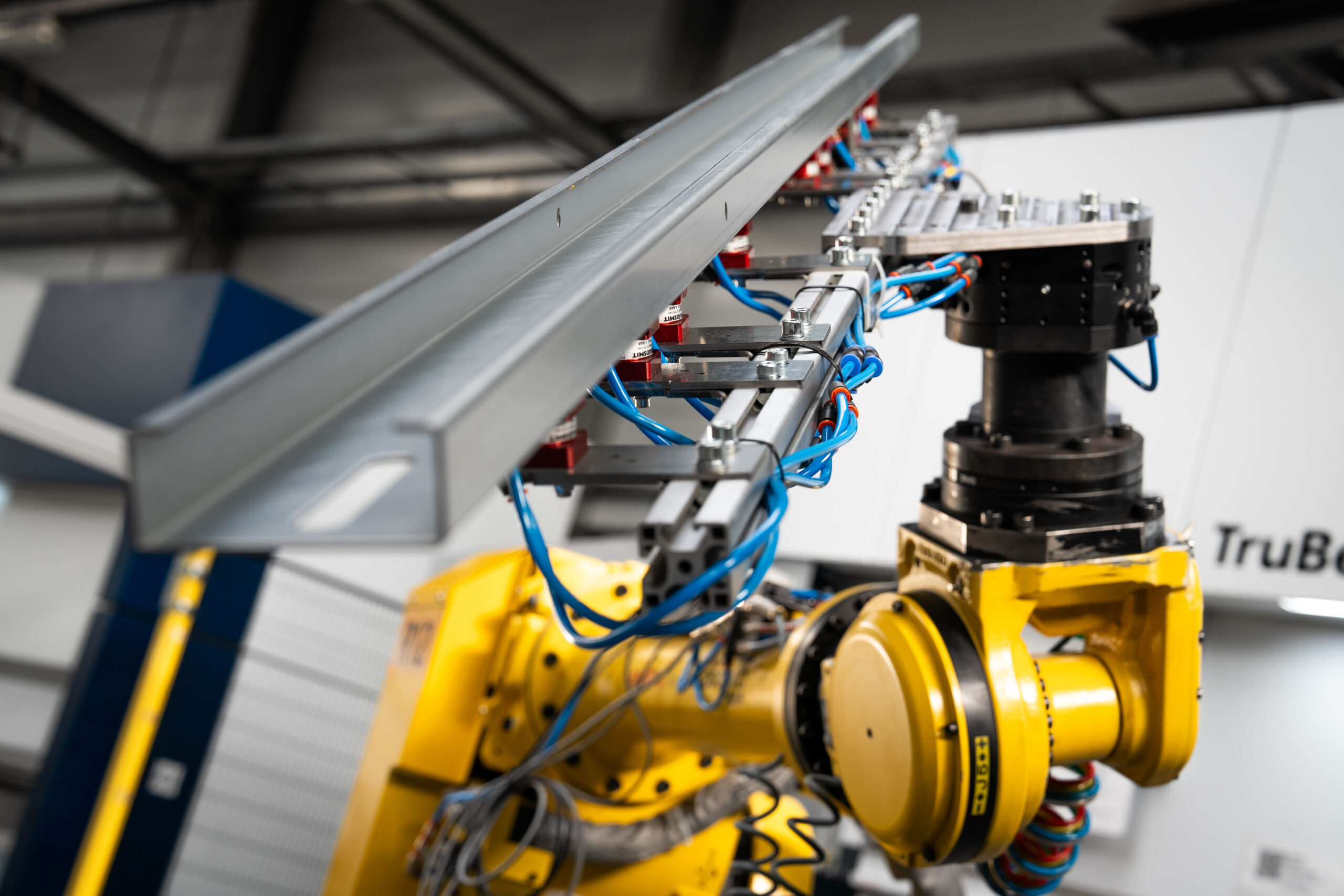
After a flat sheet has been cut, the next stage is giving it a three-dimensional form – that is, bending. The modern standard in this field is the CNC press brake – a machine that enables precise bending of sheet metal using a numerically controlled punch and die. CNC sheet metal bending makes it possible to achieve a wide variety of profiles and shapes with high accuracy in bending angles and dimensions, which is critical in the production of enclosures, control cabinets, machine panels and structural components. The process involves placing the sheet between the upper punch and the lower die of the press; the CNC controller then controls the course of the bending – the pressure, position and depth of punch penetration – to achieve the desired bending angle. Thanks to programmable parameters, it is possible to compensate for material deformation (e.g. so-called springback) and obtain repeatable results even with complex sequences of multiple bends. Modern presses are equipped with angle measurement and automatic correction systems, which further increases the precision of the process.
Precision and Repeatability of Bending
Computer control eliminates human error and ensures excellent accuracy. Typical CNC bending tolerances are in the order of tenths of a degree for angles and tenths of a millimetre for the position of the bent edge. For example, an advanced Bystronic XPERT 40/1030 press brake has a positioning accuracy of ±0.005 mm (five thousandths of a millimetre!) and a maximum bending speed of 25 mm/s. Such high precision means that even very demanding projects – such as electronics enclosures with precisely fitting bends, or structural welded components where every millimetre difference complicates assembly – can be executed without problems. Importantly, the repeatability of part positioning in a series is guaranteed: the machine reproduces the programmed bending parameters identically every time, so that all bent components are identical. According to industry sources, the advantages of CNC bending include high precision and repeatability, but also speed (shorter execution time for a series of bends) and versatility – the ability to achieve a variety of forms through the selection of appropriate tools and programs. Modern press brakes often also feature automatic tonnage selection and beam deflection compensation (so-called crowning), which maintains the bending angle along the full length of even very wide sheets.
Applications of CNC Bending
Today it is difficult to imagine the production of metal products without the bending process – most enclosures and sheet metal structures cannot remain flat. The automotive industry uses CNC bending to form body components (e.g. door skins, sill panels, reinforcing profiles), as well as smaller components – brackets, supports, engine covers. In the electronics industry, press brakes bend equipment enclosures (e.g. servers, industrial automation units), operator panels, rack cabinets – often from thin steel or aluminium sheet, where precision is essential for printed circuit boards or modules to fit the cutouts. In the furniture sector, frames of metal furniture, table legs and shelving components are bent – bending allows aesthetically pleasing, rounded shapes of structures to be achieved. The HVAC (heating, ventilation and air conditioning) sector also relies on bending, producing ventilation ducts, air handling unit housings and ventilation grilles by bending appropriately cut sheet metal blanks. In general, in the metal industry, all kinds of profiles, channels, angles, machine guards, distribution cabinets and hundreds of other components are bent. It can safely be said that if a product is to have a three-dimensional shape from sheet metal, it has probably been achieved by bending on a CNC press brake.
Modern Press Brakes
Bending machines come in many sizes and configurations, making it possible to match the equipment to the scale of production and the size of the components. Small presses (with a force of several dozen tonnes) are available for precise, small components, as well as huge tandem presses with a force measured in hundreds of tonnes, capable of bending very long sheets for the needs of the construction industry (hall structures, silos, etc.). CNC control with a graphical interface enables easy programming – often through 3D simulation of the bending process, which allows potential tool collisions with the component to be detected before actual bending. Advanced features such as automatic back-gauge setting (stops that determine the position of the sheet), laser angle measurement systems and dynamic deflection compensation mean that operation becomes simpler and results more reliable. Some presses have options for sequential bending on several axes or bending with simultaneous manipulation of the sheet position by robots – allowing very complex shapes to be produced without operator involvement. Growing automation goes hand in hand with safety – modern machines are equipped with light curtains and sensors that will stop the press if anything (e.g. the operator’s hand) enters the danger zone.
Materials for Bending
The success of the bending process depends not only on the machine, but also on the material itself. Sheets intended for plastic forming should have adequate ductility and uniformity. In practice, low-carbon steel DC01 and similar grades – so-called deep-drawing cold-rolled steel – are frequently used. These materials guarantee that no cracking or excessive hardening at the bend will occur during bending, and that springback will be predictable. For thicker structural components, hot-rolled structural steels (e.g. S350) are also used, but in this case the bending radius must be larger (thicker sheet requires a larger radius to avoid cracking). Non-ferrous metals can also be bent – aluminium (although this requires care due to the lower ductility of certain alloys) and copper – as well as perforated and open-mesh sheets. It is important to maintain appropriate quality standards – for example, many companies apply internal standards regarding the minimum permissible cracks at the bend or dimensional deviations of the finished component, to ensure consistent product quality.
Summary
CNC sheet metal bending is an indispensable technology in the shaping of metal components. Its advantages – such as high accuracy, speed and the ability to realise complex designs – translate into wide application in industry and a guarantee of final product quality. Companies investing in modern press brakes gain in production efficiency and can meet the growing market demands for complexity and precision of metal components.