Sheet Metal Perforation – What Is CNC Punching?
Sheet Metal Perforation – Hole Punching and Shape Cutting (CNC Punching)
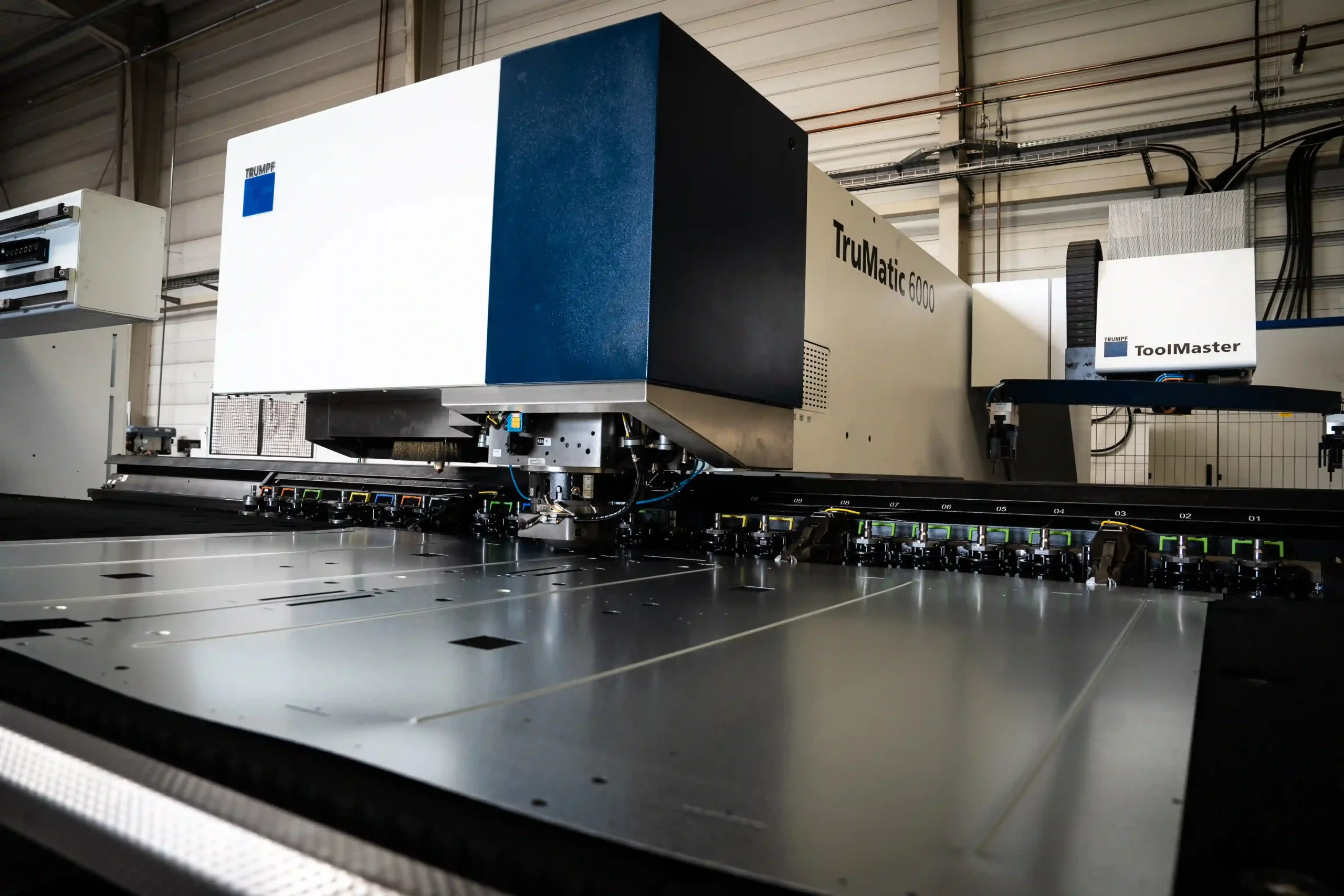
Sheet metal perforation is a process of making holes or cutting shapes in a metal sheet using punching tools. In practice, this is carried out on CNC punching machines (also known as turret presses or “punching machines”), which use a set of punches and dies to cut holes in various geometries. Perforation can take the form of regular hole grids (e.g. perforated sheet with round or square apertures) or any contour cut into the sheet, particularly using modern CNC machines. This processing method is extremely efficient in multi-batch production, especially when a component contains many repeating holes or cutouts – a single rapid punch stroke cuts a hole in a fraction of a second. Unlike laser cutting, there is no heat-affected zone or edge scorching here, which is advantageous for coated sheets or components that cannot be subjected to high temperatures. Modern CNC punch presses can work at impressive speeds and forces: typical units have a force of around 200–300 kN (several dozen tonnes), making it possible to pierce steel sheets up to 6–8 mm thick. At the same time, CNC control enables the sheet to be moved in two axes and the hole pattern to be positioned with great accuracy.
Advantages and Capabilities of Perforation (Punching)
The main advantage of punching is efficiency with large numbers of holes – where a laser would need to trace around each hole (which takes longer), a punch press does it with a rapid punch stroke. Therefore, for the production of panels with hundreds of holes (e.g. sieves, grilles, acoustic panels), mechanical perforation is more cost-effective. In addition, correctly selected tools leave minimal burr – holes are often clean and require no additional deburring. Punching also provides versatility in forming – modern machines can not only cut holes but also carry out embossing and bending. Tools such as MultiBend are available, which allow small tabs and clinches to be bent in the sheet (e.g. bending a hole edge at 90° without having to transfer the part to a press brake). Other special punches allow embossing of stiffening ribs, threaded holes, and even marking and engraving of the sheet during perforation. As a result, a single machine can fully prepare a complex component: first making all the required holes and ventilation grilles, then embossing a logo or numbers, producing threads, and finally even lightly bending certain elements. This combination of functionality significantly shortens the production chain. Furthermore, many plants use combined laser + punching machines (e.g. TRUMPF TruMatic), which combine both technologies to punch holes rapidly with standard punches and then use the laser to cut irregular outer contours and very intricate shapes.
Applications of Perforation and Punching
Perforated and punched sheet metal components surround us in everyday life and are widely used in industry. Perforated sheets as semi-finished products find application mainly in construction, automotive and agriculture, but also in interior design, industrial design, the furniture sector and even the food industry. Products made from perforated sheets include suspended ceilings, facade panels and building facades, air conditioning and ventilation covers, acoustic facade elements, stairs and open-mesh railings, storage shelves, machine enclosures requiring ventilation, and various industrial sorters, sieves and filters. Thanks to their aesthetic, original appearance, sheets with decorative perforation are willingly used as design elements – modern partitions and decorative panels in offices, furniture components (cabinet doors, chair backs), and even decorative lamps and lighting elements are made from them. In architecture, perforated sheets are used to create striking building facades and sun screens. In the automotive industry, perforated components are used for speaker grilles, car grilles, engine covers and exhaust guards. The household appliance sector uses perforated drums in washing machines, sieves in juicers and gas burners. Perforation also enables weight reduction in structures (removing material where it is not needed for strength), which is important in aerospace and machinery construction.
Summary
Like other discussed methods, CNC punching is computer-controlled on the basis of a CAD/CAM design, ensuring repeatability of even very complex hole patterns. For large batches, automation is also important – modern punch presses are equipped with feeders and automatic sheet loading/unloading systems (e.g. TRUMPF SheetMaster), enabling continuous operation without interruption. This makes it possible to economically produce both large series (hundreds of thousands of identical perforated sheets) and cost-effective prototyping or small batches (the CNC programme can be quickly adapted to a new hole pattern without expensive retooling). All this makes perforation and punching an indispensable part of sheet metal processing services in modern companies – complementing laser cutting and bending, they allow customers to be offered comprehensive solutions in the field of metal processing.