Modern Sheet Metal Processing – A Guide to Perforation, CNC Bending and Laser Cutting
Sheet metal processing is a key element of many industries – from construction and architecture to machine engineering and automotive. Modern technologies have significantly expanded the possibilities for precise sheet metal processing, combining high accuracy with efficiency. This guide discusses three pillars of modern sheet metal processing: sheet metal perforation (CNC punching), bending on CNC press brakes, and laser cutting. You will learn what these processes involve, what benefits and applications they offer, and how they are used to realise even the most demanding sheet metal projects.
Sheet Metal Perforation and Punching
Sheet metal perforation involves the mechanical punching of holes or shapes in a metal sheet using a punch and die that press on the sheet with enormous force. A punch press (e.g. TruPunch), as a turret press equipped with a rotating head with a set of tools, strikes designated points on the sheet and cuts out pieces of material, creating holes or a chosen pattern. The entire process is computer-controlled – the operator prepares the CNC programme based on a CAD design, and the machine automatically positions the sheet and tools to realise even hundreds or thousands of identical cutouts with accuracy to tenths of a millimetre. Perforation is not limited to round holes: thanks to interchangeable punching dies, square holes, elongated slots or any other shapes available as tools can be obtained – and through so-called nibbling (a series of overlapping punctures with a small punch), more complex contours can also be cut.
Advantages of Modern Punching and Perforation
The main advantage of mechanical perforation over other cutting methods is efficiency for serial holes. A punch press makes one cutout in a fraction of a second – the best machines achieve speeds of up to ~1,600 strokes per minute, meaning thousands of holes can be punched in a short time. CNC control guarantees repeatability: every hole has the same diameter and is exactly at the programmed location. Modern punch presses also offer great flexibility – they can process sheets of e.g. 3,000 × 1,500 mm as standard, and TRUMPF machines can process even larger formats (up to 8,000 mm long) thanks to a repositioning function. The turret head rotates tools through 360°, allowing cutting at various angles without repositioning the sheet, speeding up the process and maximising material utilisation.
More Than Just Holes
Sheet metal perforation on a punch press is not only about punching holes. Using appropriate punches and dies, additional technological operations can be performed in the same process, such as: marking (e.g. part numbering), embossing of stiffening features, forming flanges for threaded holes, and even pre-bending small tabs or catches within the component outline. This means many components can be largely completed at the punching stage, without the need for separate processes – saving time and costs.
Sheet Metal Bending on Press Brakes
After a flat sheet has been cut (whether by punching or laser cutting), the bending stage arrives – giving it a three-dimensional form by folding at a specific angle. The machines designed for this task are press brakes, equipped with an upper punch (the bending blade) and a lower V-shaped die (the groove). The sheet is placed between them and the pressure of the punch causes the plastic deformation of the metal – bending the sheet along a line. In modern CNC press brakes the entire process is precisely computer-controlled: the machine sets the appropriate position of the back gauge (the stop against which the sheet edge is pressed to define the bend line) and the depth of the punch into the die, which determines the bend angle. The CNC controller takes the material properties (thickness, springback) into account and automatically corrects parameters to achieve exactly the angle the operator has programmed.
Precision, Repeatability and Automatic Correction
Modern press brakes are equipped with advanced measurement systems that control the bend angle during the operation itself. An example is Laser Controlled Bending (LCB) technology used in TRUMPF machines: a laser sensor measures the actual angle at which the sheet bends during pressing and feeds information to the controller, which can correct the pressing depth in a fraction of a second. This eliminates even minimal deviations caused by differences in material springback. Additionally, CNC press brakes feature automatic crowning compensation – at long bends, the press beam can deflect minimally in the middle, which would affect the angle at the ends. The compensation system detects this and gently counter-bends the table, so the angle is identical along the entire bending length. PG Group has presses allowing bending of sheets up to 8.3 metres long and 15 mm thick, enabling the forming of very large components.
Laser Cutting – Fast and Accurate
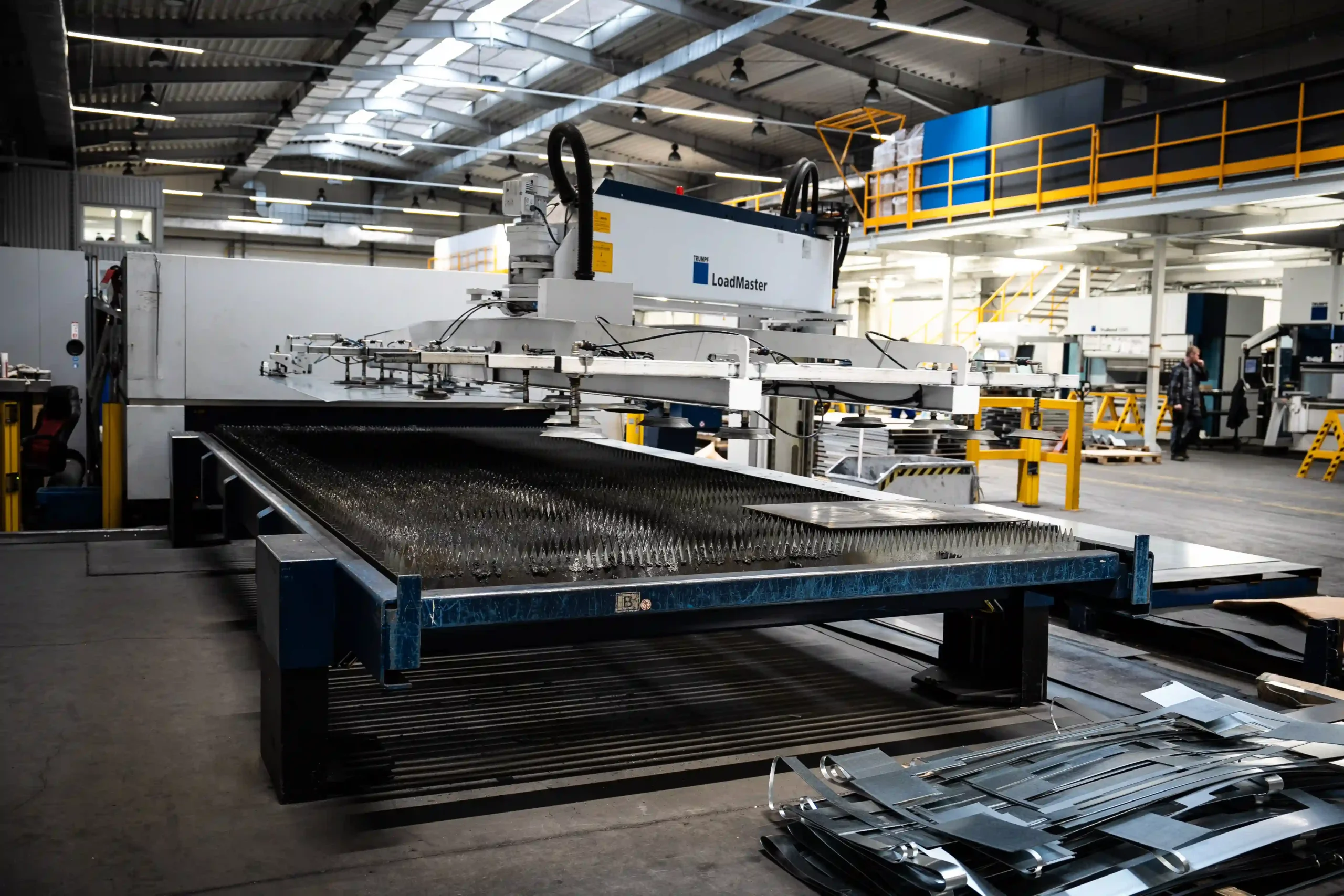
Laser cutting is a technology that uses a focused, high-energy laser beam to cut through material. The laser head moves over the stationary sheet, directing an intense beam at the selected location. The beam locally heats the metal to melting (or even vaporisation) temperature in a fraction of a second, creating a narrow gap. Simultaneously, a nozzle coaxial with the beam blows a stream of technical gas (usually nitrogen or oxygen) which expels the molten material from the gap and maintains process cleanliness. The result is a cut sheet – the laser moves along the programmed path, cutting even very complex shapes with extraordinary precision. Clean edges are the hallmark of laser cutting: with well-set parameters there are no burrs or ragged edges (often so smooth they require no further processing). The cutting kerf is very narrow – in the order of 0.1–0.3 mm – allowing optimal sheet nesting and material savings.
Modern Fibre Lasers vs CO₂
Fibre lasers now dominate, having replaced CO₂ lasers in many applications. A fibre laser generates a beam at a shorter wavelength (near-infrared range), resulting in better energy absorption by metals and the ability to cut highly reflective materials (copper, brass, aluminium) – which CO₂ could not safely do. Fibre lasers also have significantly higher energy efficiency and lower operating costs. For the customer, the result is that laser cutting has become even more cost-effective and versatile. Typical industrial laser powers (3–8 kW) allow cutting of structural steel up to 20–25 mm thick, stainless steel to ~20 mm, aluminium to ~15 mm. PG Group’s TruLaser 3060 with a 6,000 × 2,500 mm working area can cut very large sheets or many smaller components in a single setup.
Summary – Synergistic Use of Technologies
Modern sheet metal processing often combines the technologies described above. The production process of a typical component can proceed as follows: a large sheet is first cut (mechanically on a CNC punch press or by laser) into smaller blanks with the required contours and holes, and these blanks are then bent on CNC press brakes to give them the desired three-dimensional shape. Sometimes both cutting stages are combined – some holes are punched and more complex shapes are laser-cut on a single hybrid machine. Either way, perforation, CNC bending and laser cutting complement each other, allowing progress from raw flat sheet to a finished product in line with the design. PG Group, specialising in precision sheet metal processing, is able to offer clients a full package of services: from rapid perforation through accurate laser cutting to complex CNC bending of large formats – ensuring shorter order fulfilment times, lower material losses and high-quality end products.