Automation and Robotisation – Industry 4.0 in Metal Processing and Component Prefabrication
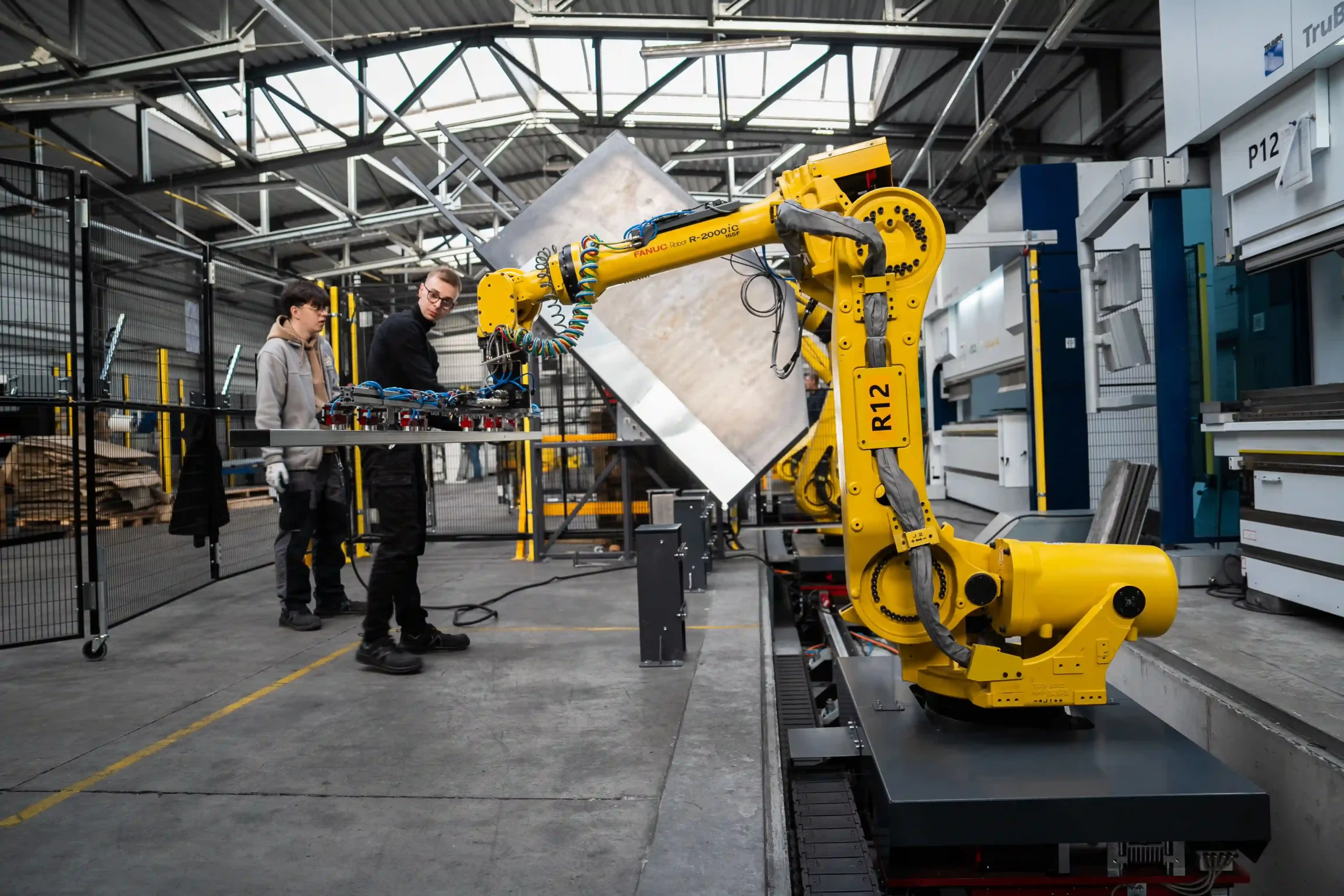
In the age of Industry 4.0 and increasing competitiveness, production automation is becoming a key success factor in the metal processing sector. Companies involved in the prefabrication of metal components are increasingly implementing robotisation and advanced digital technologies to increase production efficiency and reduce costs. Traditional, fully manual methods are giving way to modern solutions that minimise the human factor in routine operations. Below we look at how Industry 4.0 is affecting sheet metal cutting, punching and bending processes, and what benefits – in terms of efficiency and costs – the application of automation and robotics in serial metal component production brings.
Key Elements of an Automated Production Environment
Today’s modern manufacturing plants combine a range of advanced devices and systems to create integrated smart factories. The most important elements of such an automated production environment include:
- Laser cutting machines – provide fast and precise laser cutting of sheets of various thicknesses. Fully digital control allows complex shapes to be cut with accuracy in the order of fractions of a millimetre. Modern fibre lasers are also highly energy-efficient and feature automatic pallet changers, reducing machine downtime.
- CNC punch presses – automatic machines for punching holes and shapes in sheet metal, allowing thousands of holes or embossings to be produced rapidly with high repeatability. Combined machines (e.g. TruMatic) combine punching and laser cutting in a single cycle.
- Press brakes – enable precise bending of sheet metal with high force and accuracy to hundredths of a millimetre. Increasingly integrated with robots for part loading and unloading, speeding up work and protecting operators from injuries.
- Industrial robots – perform a wide variety of tasks in the production process – from loading sheet metal onto machines, through collecting and sorting cut components, to assembly and welding. Robots can continuously perform repetitive tasks 24/7, significantly raising safety and production speed.
- Integrated ERP system – software managing production that links all of the above elements into a single coherent ecosystem, plans orders, schedules machine work, manages inventory levels and monitors order completion in real time.
Automation as the Key to High Quality and Efficiency
The main goal of automation is to maximise the efficiency of serial production while simultaneously optimising product quality. Industrial robots can perform repetitive tasks practically without interruption – they do not tire and do not need rest, meaning production can continue uninterrupted even in 24/7 mode. Companies implementing robotic laser welding systems have recorded approximately 30% efficiency gains compared to former manual methods. Automation of material transport and feeding also delivers measurable results – studies indicate approximately 25% productivity growth following the implementation of automated magazine-feeding systems for machine tools. In some operations, processing time was halved compared to manual work.
CNC machines controlled by computer guarantee identical quality for every component produced, which is crucial in mass production. Dimensional deviations are minimal (often measured in hundredths or thousandths of a millimetre), and every unit in a batch is practically identical. Modern sensors and vision systems can continuously monitor quality – scanning cut contours or measuring bend angles – so any deviations are immediately detected and corrected. This allows a near-zero defect and complaint rate to be maintained. Automation also reduces material waste – precise cutting and bending minimises production offcuts.
Lower Production Costs Through Automation
Cost reduction is the second key argument – alongside efficiency and quality – for implementing automation in metal processing. Although the investment in robots and advanced CNC machines involves a high entry barrier and high initial expenditure, properly utilised technology pays back quickly through a reduction in unit production costs:
- Labour costs – replacing some workers with industrial robots significantly reduces wage, training and recruitment expenditure. Manufacturers report on average approximately 30% reduction in labour costs after automating processes, though the exact figure depends on the sector and scale of implementation.
- Less material waste and error reduction – automated systems cut and shape material with high accuracy, minimising waste. According to some analyses, companies that implemented modern automation recorded on average as much as 85% cost optimisation in production areas, resulting from reductions in material losses, quality defects and downtime.
- Higher energy efficiency – new CNC machines (especially fibre lasers) and robots are designed with energy savings in mind. Some plants recorded a drop in energy consumption of approximately 30% after switching from traditional to fully automated lines.
- Constant unit cost as scale grows – automation particularly pays off in mass production or long component series. When the line is already running and optimised, increasing production volume does not cause a proportional increase in costs.
Benefits for Serial Production and B2B Subcontracting
The advantages of automation described above – higher efficiency, repeatable quality and lower costs – translate directly into benefits for clients commissioning production to subcontractors. Computer-controlled processes are far more predictable than purely manual work. Eliminating human error means the risk of receiving a batch of defective components drops dramatically. Automatic quality control catches any deviations before the product leaves the factory, so the client receives components conforming to specification, ready for assembly without additional sorting. For clients, this translates into shorter waiting times for components and the ability to bring their own products to market more quickly.
Thanks to Industry 4.0 solutions such as ERP system integration, cooperation in the B2B outsourcing model becomes more transparent and efficient. The ability to remotely monitor order status, track production progress or quickly exchange data (e.g. modifications to technical drawings) means that subcontracting no longer implies losing control over the process. An innovative manufacturer can provide the client with real-time production reports and automatically notify them of the completion of successive batches.
Summary
In summary, contracting serial production to a company using automation and robotisation means less risk, lower costs and higher quality for the client. Industry 4.0 in metal processing translates into measurable results: faster production, repeatable quality and optimised unit costs. Industry data confirms that automation can increase production efficiency by as much as 30% and significantly reduce operating costs. Companies looking for serial metal component manufacturers should therefore pay attention to whether a potential partner has a modern, automated technological base: CNC laser cutters (e.g. Trumpf TruLaser, TruMatic), CNC punch presses (e.g. TruPunch 3000 and 5000), CNC press brakes (e.g. TruBend 5230), industrial robots (e.g. FANUC) and an integrated ERP system. Long-term cooperation with such a partner brings mutual benefits – the client receives products better, faster and more cheaply, while the supplier strengthens the business relationship and can plan further development around the specific needs of the client.